Forming an LLC in the United States from abroad is today a relatively straightforward process. Finding the right banking institution to operate that structure is, however, a question that deserves careful attention.
Not all banks are equal when it comes to the specific needs of non-resident LLC owners, and the choice of financial institution can have a direct impact on the smoothness of day-to-day business operations.
Mercury: The Reference for Non-Resident-Owned LLCs
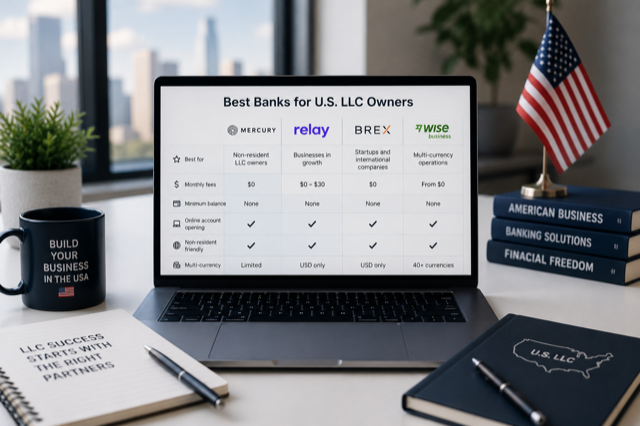
Among all the solutions available on the market, Mercury has established itself as the go-to platform for foreign entrepreneurs holding a US LLC.
Founded in 2019 and operating in partnership with FDIC-insured banks, Mercury offers fully online account opening with no requirement for physical presence in the United States — a considerable advantage for a director based in Europe, Asia, or elsewhere.
The interface is clean and efficient: ACH and Swift transfers, virtual and physical cards, multi-user management, and accounting integrations with QuickBooks, Stripe, and Gusto. Mercury charges no monthly fees for its basic account and requires no minimum balance.
For LLCs in the startup phase or generating modest cash flows, this is a meaningful benefit.
On the documentation side, Mercury requires the EIN, LLC formation documents (articles of organization, operating agreement), and a valid ID for all beneficial owners.
The identity verification process is carried out remotely via a secure platform. The acceptance rate for well-prepared applications is considered high, although Mercury reserves the right to decline businesses deemed high-risk (crypto assets, unlicensed financial services, etc.).
Relay: A Solid Alternative for Growing Structures
Relay is another US neobank that has carved out a strong position in the small and mid-sized business segment, including structures owned by non-residents.
It stands out by allowing up to twenty separate accounts within a single entity — a feature valued for segregating cash flows (operating treasury, tax reserves, contingency savings). Relay also offers physical and virtual cards with no foreign transaction fees, along with native integrations with QuickBooks and Xero.
Account opening is done online, with documentation requirements similar to Mercury. Relay is particularly well suited to e-commerce businesses, service providers, and agencies managing multiple revenue streams simultaneously.
Brex: Built for Internationally Minded Startups
Brex was initially designed for fundraising-stage startups before broadening its offering to international SMEs. Its value proposition centers on high spending limits, attractive rewards programs, and advanced team expense management.
Brex does not offer a traditional checking account in the strict sense, but rather a combination of a cash account and a corporate credit card.
For LLCs with non-resident members, Brex imposes stricter eligibility criteria than Mercury or Relay, particularly regarding transaction volume or capital raised. It is better suited to an established structure than to a newly launched entity.
Wise Business: The Solution for Multi-Currency Flows
Wise Business — formerly TransferWise — is not a bank in the US regulatory sense, but an electronic money institution offering multi-currency accounts with local banking details in around ten countries, including the United States.
For an LLC whose clients or suppliers are spread across multiple continents, Wise Business is a particularly effective complementary solution for avoiding conversion fees.
Account opening is entirely online and accessible to non-residents. That said, Wise Business does not offer full banking features (no checkbook, no lending, limited FDIC coverage) and should not be considered as a standalone solution for a high-volume operation.
Traditional Banks: Mercury First, Classic Banking Later
Some LLC owners ultimately want to work with a traditional US bank — Bank of America, Chase, or Wells Fargo — for reasons of commercial credibility or access to credit. These institutions generally require a physical branch visit and more extensive supporting documentation.
In practice, the most common approach is to open a Mercury or Relay account first to get the business running without delay, then approach a traditional bank once the LLC has an established banking history and documented transaction volume.
Selection Criteria
The choice of bank ultimately depends on several factors: the nature of the business activity, the volume and frequency of transactions, the currencies involved, the accounting integrations needed, and the institution’s risk tolerance toward the relevant industry.
A well-prepared file — EIN, complete corporate documents, a letter explaining the business activity — significantly increases the chances of acceptance, regardless of the platform chosen.
For the vast majority of non-resident LLC owners, Mercury remains the most logical starting point: accessible, fee-free, technologically well designed, and experienced in handling international applications.
Case Study: An E-Commerce LLC Quickly Secures Its US Banking Solution — Mercury
A Europe-based entrepreneur had formed an LLC to sell products on the American market. After some research, he was weighing several banking platforms and concerned his application might be rejected due to his non-resident status.
After reviewing his business activity, projected cash flows, and operational needs, we directed him toward a banking solution suited to his business model — Mercury. We also assisted him in preparing the necessary documents, including the EIN, the LLC’s formation documents, and a detailed description of the business activity.
The account was approved within just a few days, enabling the company to receive payments in US dollars, pay international suppliers, and seamlessly integrate its accounting and online payment tools.
This experience demonstrates that the choice of bank should not be based solely on the institution’s reputation, but above all on the fit between the bank’s requirements and the company’s actual profile.
Which Bank Is Really Right for Your LLC?
Every US bank applies its own acceptance criteria. A solution perfectly suited to a consulting business may be entirely inappropriate for an e-commerce company, a marketing agency, or an international services firm.
Our team assists foreign entrepreneurs in choosing the bank best suited to their US LLC, preparing the account-opening file, and ensuring all required documents meet compliance standards.
Drawing on our experience with numerous US banking platforms and fintechs, we can point you toward the institutions most likely to accept your profile.
Have you already formed an LLC, or are you considering doing so? Contact us for a personalized analysis and to identify the best banking solution for your business.